
Saratoga County Resident Lookup Records
A Saratoga County name check is a set of separate records, not one master database. The right source depends on the question. The assessment record can connect a person to a recorded parcel. A court index can supply a case number and party role. A vital-record route can address an older death, marriage, or family-history question when its eligibility rules are met. Each source has a different keeper and a different limit.
| Record | What It Confirms | Where | Access |
|---|---|---|---|
| Assessment and parcel record | Recorded owner, mailing address, property location, and SBL | Saratoga County PROS | Public online search; local assessor can answer record questions |
| Land document | Party role, legal parcel relationship, and recording date | SearchIQS | Free account or County Clerk public computer; copies have posted fees |
| Voter record | A registered-voter match, status, and district information when lawfully available | NYS VoterLookup | Name, date of birth, county, and address or ZIP are required; election-purpose limits apply |
| Court docket | Case number, court, party name, appearance, or status | NYS eCourts | Free web lead; sealed and other protected cases remain unavailable |
| Vital record | Birth, death, marriage, or divorce fact under eligibility rules | NYS Department of Health | Local registrar, county historical marriage layer, or state form route |
| License or entity filing | Public professional or business affiliation, not a home address | NYS Licensee Name Search | Public search fields vary by record type |
Start with PROS when the person may own property. Start with VoterLookup only when the required identifying fields are known and the use complies with election law. Use eCourts for a court lead, not as an identity verdict. If the question is about a past family event, use the custodian that holds that event rather than treating a directory entry as a certificate.
Saratoga County Name Match
Names repeat, and Saratoga can mean the county, the City of Saratoga Springs, a town, a village-era record, or a seasonal address. Match at least two independent details before treating records as belonging to one person. Useful pairs include name plus SBL or legal description, name plus a date of birth in an authorized voter search, and name plus a dated court index number and municipality. Initials, maiden names, former names, spouses, and corporate names can explain an apparent miss.
PROS accepts an owner name in Last, First form and can return a tax-roll mailing address, property location, sale context, assessment information, and the SBL. That is a documented property relationship. It is not proof that the owner lives at the parcel, because the mailing address can be elsewhere. Keep the property location, mailing address, and legal description in separate notes.
The County Clerk's SearchIQS instructions show why spelling and order matter: Party 1 is entered last name first without a comma, then results open through the View control. After locating a land document, record the party role, recording date, document number, book or page reference, and legal description. A grantor, grantee, mortgagor, or lien claimant is a role in a filing, not a statement of current residence.
Note: A mismatch can reflect a spelling variant, a different municipality, an unrecorded ownership interest, or a protected record.
Saratoga County Resident Voter Check
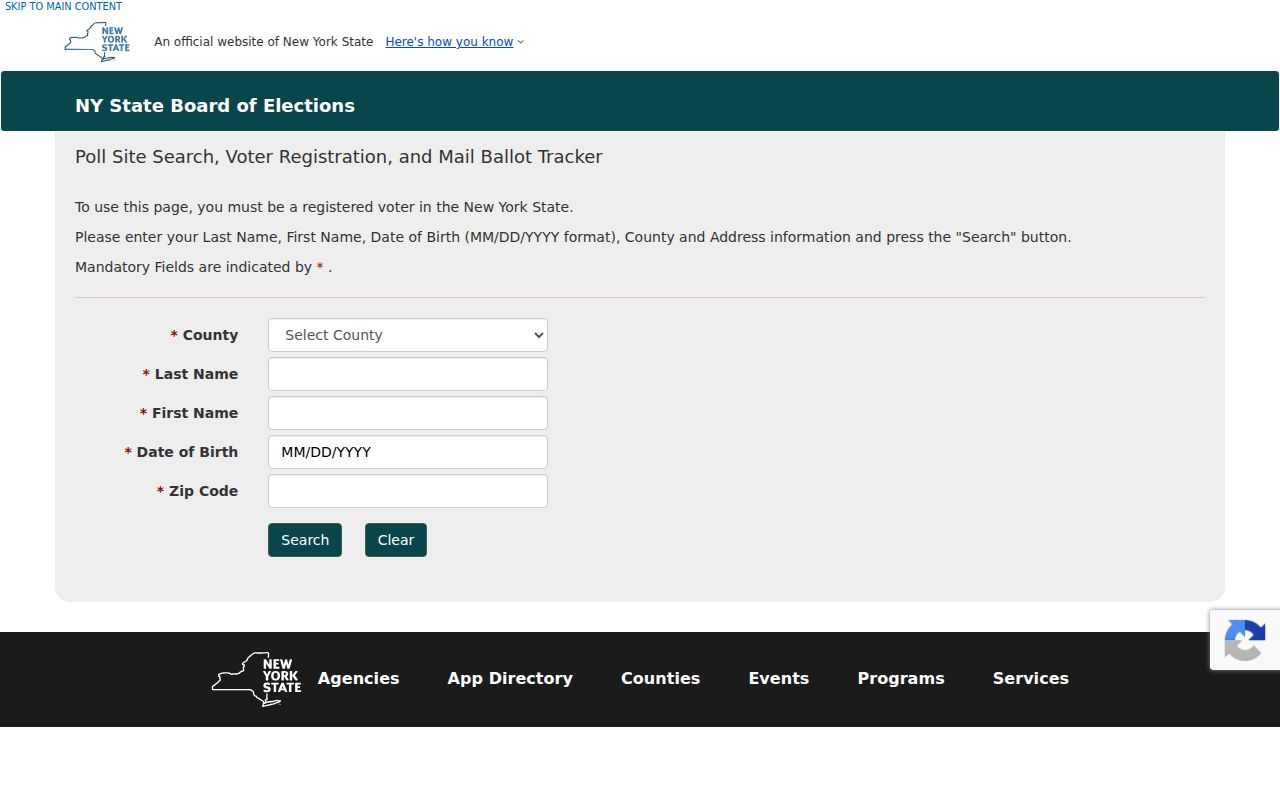
New York's official voter form is designed to confirm one registered voter, not to browse people by name or street. It calls for county, last name, first name, date of birth in month/day/year format, and address or ZIP information. Select Saratoga County only after checking that the person is registered in the county. A result can support a match; a missing result can also reflect an address change, a typo, a different county, list status, or confidential registration.
The official NYS VoterLookup capture shows the identifying fields used for a Saratoga County voter check.
Election Law §3-220 permits supervised public inspection of registration records while withholding sensitive identifiers. Election Law §3-103(5) limits voter-derived information to an elections purpose. For a registration question, the Saratoga County Board of Elections provides the local phone and counter route; a statewide file request requires the State Board's prescribed purpose statement.
Saratoga County Resident Court Results
NYS eCourts is the online starting point for party-name research. WebCivil Local and WebCivil Supreme have party, index, attorney or judge modes; WebCriminal can search a case or summons number, a defendant name, or a court calendar. WebFamily and WebSurrogate are separate paths with more limited public detail. Search a full name and a documented variation, then retain the case number and court before making any conclusion.
A court hit is only a lead. The eCourts service can omit sealed cases, youthful-offender matters, adoptions, cases not yet entered, some family matters, and some local civil cases outside the displayed calendar window. A complaint or judgment also has to be read for its status and disposition. The entering court, not the web result, handles an accuracy correction or a request for the underlying file.
| Result field | What it can show |
|---|---|
| Case or index number | The number needed to identify the filing at court or the County Clerk. |
| Party name and role | The name as indexed and the person’s role in the case, not a final identity match. |
| Attorney or firm | Listed counsel where the service displays it. |
| Court and part | The court, calendar part, justice, or judge associated with the result. |
| Appearance or calendar date | A scheduled court event when available. |
| Active or disposed status | The service status shown for the case type; it must be read with the docket. |
The Saratoga County Clerk provides the offline bridge for local files and public computers. Write down the number, court, party role, filing date, and document requested before using the counter. Divorce files have separate restrictions, and adoption, guardianship, juvenile, sealed, and expunged records are not open merely because a name is known.
Saratoga County Vital Record Routes
Vital records are organized by where an event occurred, not by a person's current address. Saratoga Springs and each town or village clerk act as local registrars for their own events. The New York Department of Health is the statewide route when the municipality is unknown or its process is needed. Saratoga County Clerk holds a historical layer of county marriage records created from 1908 through 1935. A divorce certificate is obtained through the Department of Health, while the court file and judgment follow separate access rules.
For older family-history research, the Department of Health genealogy program sets its own periods: births require at least 75 years and a known death, deaths require 50 years, and marriages require 50 years with both spouses known deceased. Direct-line descendants may provide proof to seek a waiver of the ordinary period. The official capture records the genealogy route and application information.
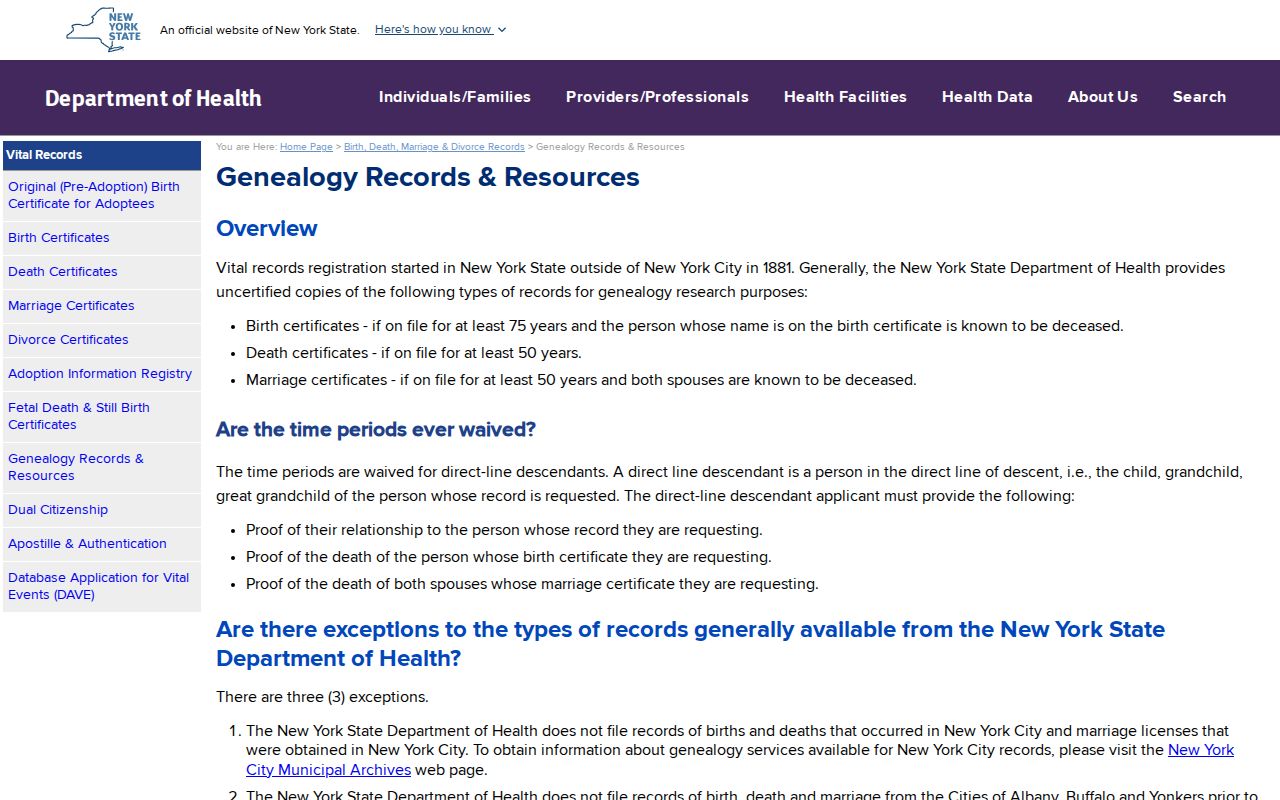
A genealogy response is uncertified and does not establish a current address. Current certified copies have eligibility, identification, fee, and form rules. The state lists regular certified-mail handling of 10 to 12 weeks, while its genealogy process can take eight months or longer. A local registrar can be a more direct route when the event municipality is known and the requestor is eligible.
Note: Cemetery cards, obituary notices, and family Bible material are valuable leads, but they are not certified vital records.
Adoption Registry Reunions
For a birth-parent, adoptee, or biological-sibling reunion question, New York uses the confidential Adoption Information Registry rather than an open record search. Registered participants may receive available non-identifying information or be connected through the registry's lawful process. Adoption and birth records remain confidential and under court seal, so an ordinary name search is not a substitute for the registry.
That distinction protects everyone involved. For former classmates or relatives outside the adoption process, the Saratoga Room's yearbooks, newspaper microfilm, vertical files, and local-history material can supply a historical lead. Confirm a name with a graduation year, town, dated directory entry, cemetery record, probate file, or other custodian-held evidence before treating it as the same person.
Verify a Saratoga County Resident
A careful resident lookup has one goal: test whether separate records refer to the same person. Keep the sources in their proper lanes. A parcel record may confirm recorded ownership, a voter record may confirm a qualifying registration match, a court docket may identify a party to a case, and a vital route may establish an older event. Do not fill gaps by assuming that a mailing address, docket, or license record proves every fact about a person.
- Search the name in PROS in Last, First order. Save the SBL, property location, owner mailing address, and municipality without calling the mailing address a residence.
- Use the SBL and legal description to keep the parcel distinct, then search SearchIQS Party 1 for the owner or prior recorded party. Preserve the document number, role, and recording date.
- If a voter check is lawful and the necessary details are known, compare the authorized VoterLookup result with the county, date of birth, and address information. Do not use voter-derived information outside its permitted election purpose.
- Run the same name and variants in eCourts. Compare court, party role, case number, and date with the existing record trail, then ask the entering clerk for file access or corrections.
- For an older relationship, death, or marriage question, use the correct local registrar, the County Clerk's 1908–1935 marriage layer, or the Department of Health form. Order a certified copy only from its legal custodian when eligible.
For a whole named street or a parcel-by-parcel address trail, use the Saratoga County street directory rather than trying to stretch a one-person check into a block search. Its address workflow keeps property, parcel, and historical street evidence in the right order.
Saratoga County Record Vocabulary
Record terms matter because they tell a reader what was actually found. A search index is a locator. It may point to a document without reproducing the complete filing. The image or paper file can carry the details needed to evaluate it, subject to access rules. A certified copy is a custodian-issued copy with the certification needed for an official purpose, not simply a downloaded screen.
- Docket
- The court's running case record, often showing a case number, parties, events, and status.
- Index
- A searchable list of record references, such as names, dates, and document or case numbers.
- Image
- A scanned or viewable copy of the underlying deed, filing, or other document when the custodian makes it available.
- Certified copy
- A copy issued and certified by the legal custodian under that record's eligibility and fee rules.
SearchIQS can supply a document index and image-navigation path, while the County Clerk's public computers provide an in-person alternative. For vital records, email may answer a general question, but the Department of Health says email is not the record-request channel.
Saratoga County Correction Routes
Correct an error with the office that maintains the record. A PROS or tax-roll issue goes to the local assessor. A deed or index issue goes to the County Clerk. A court data issue goes to the entering court, a voter issue to the Saratoga Board of Elections, a vital-record issue to the issuing registrar or Department of Health, and a licensing or entity issue to the Department of State. The person reporting the error should preserve the record number and the evidence supporting the correction.
When an online route ends, New York's Freedom of Information Law is the documented request channel for records that are legally available. A reasonably described request can be made through the custodian's designated route. The general rule calls for a grant, denial, clarification, or acknowledgement within five business days, but FOIL does not override a sealed court file, vital-record restriction, protected voter information, or another confidentiality statute.
Note: A custodian can explain its request process, but only that office can decide whether a particular record may be released.
Saratoga County Lookup Limits
A Saratoga County resident lookup has deliberate blind spots. The New York Address Confidentiality Program uses a substitute address for qualifying participants, and confidential voter registration keeps a qualifying record separate from public inspection for four years. Sealed court files, adoption matters, certain juvenile records, sensitive identifiers, and protected addresses are not gaps to work around. A missing result can be the correct result.
Lawful use. Use Saratoga County records for personal, lawful research, family history, reconnecting, civic questions, or fraud verification. Never use a record to stalk, harass, threaten, intimidate, or harm another person.
For address protection information, consult the New York Address Confidentiality Program rather than asking a local office to expose a protected location. DMV address data is also restricted. If a public result appears wrong, use the correction route for the custodian that created it.